The hidden history of ramen noodles

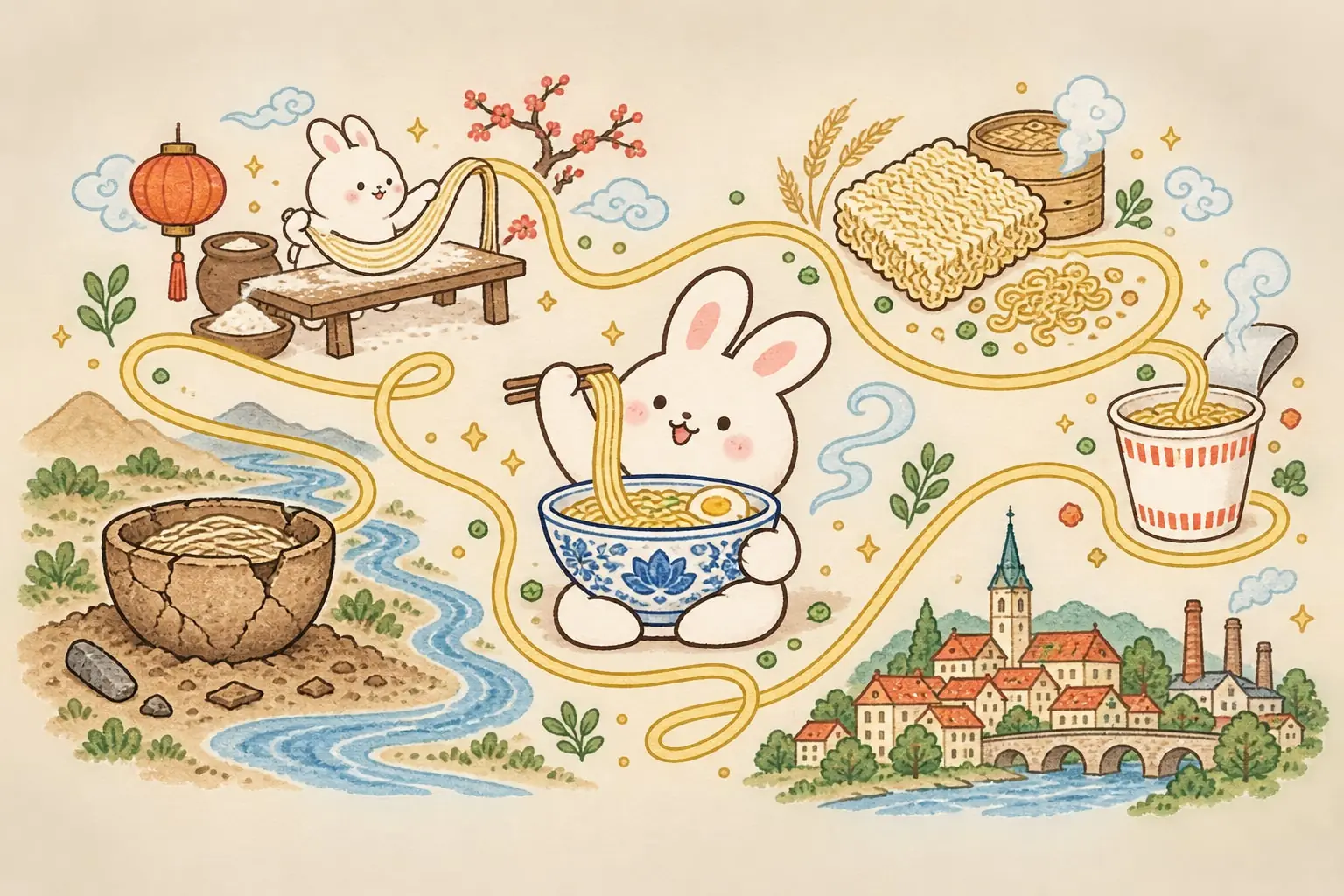
Ramen feels as Japanese as sushi, but the noodle in the bowl started its life in Chinese kitchens in a port city, went through a name change, a war and a black market, and only then became Japan’s national comfort food. Its story also explains what ramen noodles are made of, why they are yellow and springy, and why they behave so differently from udon or egg noodles. Here is the hidden history of ramen noodles, and what it means for a professional kitchen today.
What are ramen noodles?
Ramen noodles are thin wheat noodles made with alkaline salts. That small addition gives them three things that ordinary wheat noodles do not have: a pale yellow colour, a firm and springy bite, and a slightly slippery surface that carries broth well. In Japan the noodle itself is called chūkamen, literally “Chinese noodles”, which is the first clue to where it came from.
Our ramen noodles are pre-cooked and ready in 3–4 minutes.
The hidden history of ramen
Yokohama, late 19th century: “Nanjing noodles”
According to the history of ramen, the dish can be traced back to Yokohama Chinatown in the late 19th century. Chinese immigrants served many different noodle soups under their own names, but the Japanese simply called them all Nankin soba, “Nanjing noodles”, after the popular name for the Chinatown districts. In 1899 a new law allowed foreign residents to run businesses outside their settlements, and Chinese noodle shops began to spread across Japan.
There is an older story too: one theory says a Chinese scholar, Zhu Shunsui, served noodles to the feudal lord Tokugawa Mitsukuni in the 1660s. But those noodles were made with lotus root starch, not the alkaline dough of modern ramen, and historians consider the Yokohama route far more plausible.
1910: the first ramen shop
The first shop dedicated to the dish, Rairaiken, opened in 1910 in Asakusa, Tokyo. Its Japanese founder, Kan’ichi Ozaki, hired twelve Cantonese cooks from Yokohama’s Chinatown and sold the noodles as shina soba, “Chinese noodles”. After the Second World War that name fell out of use and was replaced by chūka soba, which you can still find on menus today.
After the war: wheat, food stalls and the black market
The real ramen boom came out of hardship. In December 1945 Japan recorded its worst rice harvest in 42 years. Wheat flour, much of it imported, filled the gap, and it ended up not only in bread but in noodles sold at black-market food stalls. It was only in 1947 that the word ramen was first recorded in Japan for this dish. By 1950 the controls on flour were lifted and street vending loosened; companies even rented out ready-made yatai (food stall) kits with noodles, toppings, bowls and chopsticks. Ramen became the food of a country getting back on its feet.
1958: instant ramen
Then came the invention that took ramen around the world. In 1958 Momofuku Ando launched Chikin Ramen, the first packaged instant noodles, and the name ramen spread across Japan with it. We tell that part of the story, and how frying became a way to dry noodles, in a short history of noodles.
The word “ramen”
The word itself is usually linked to Chinese lamian, “pulled noodles”. But the dish does not actually come from northern Chinese lamian; it grew out of southern Chinese noodle soups, and even food historians admit it is unclear how ramen ended up with that name. Our ramen noodles follow the lamian tradition in style: thin, springy and made for broth.
What are ramen noodles made of?
Most ramen noodles are made from just four ingredients: wheat flour, salt, water and kansui. Kansui is alkaline mineral water containing sodium carbonate and usually potassium carbonate, and it is the secret of ramen.
The alkaline salts react with the flour: its natural flavones turn yellow, and the gluten network becomes tighter. That is why ramen noodles are yellow without any egg, and why they are more elastic than ordinary wheat noodles and keep their shape in hot broth. It is also why ramen looks and bites differently from Italian pasta or from udon, even though all three are made from wheat.
Are ramen noodles pre-cooked?
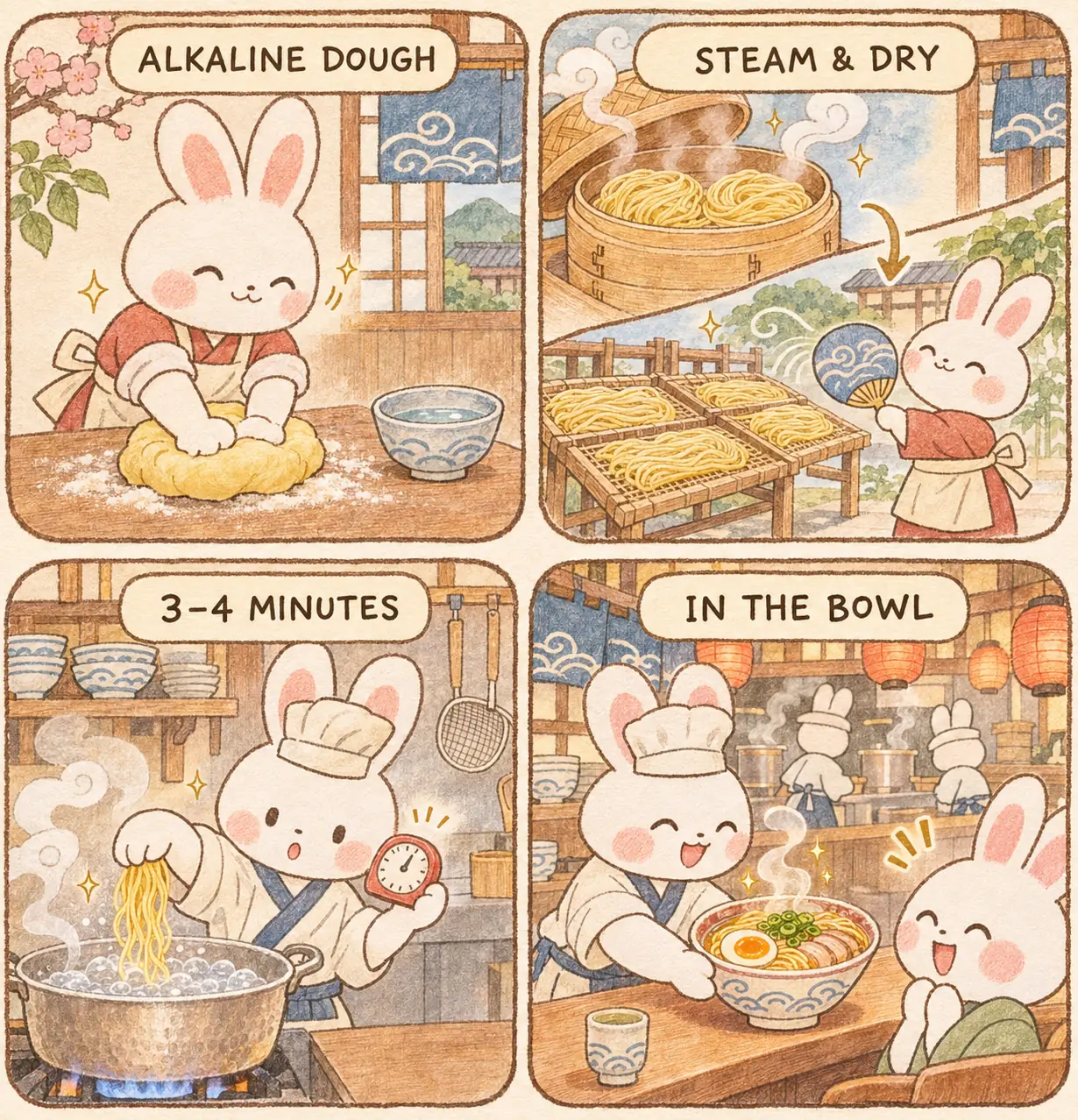
Fresh ramen noodles are not: they are cooked from raw in the restaurant. Instant ramen blocks and quick cooking ramen noodles are. Ours are steamed at the factory and then dried without frying:
- Mixing. Wheat flour, water, salt and alkaline salts are mixed into a crumbly dough.
- Sheeting and cutting. The dough is rolled into a sheet in several passes and cut into thin strands.
- Steaming. The strands are steamed until the starch is cooked through.
- Drying. The cooked noodles are dried without frying, so there is no oil bath and no oil uptake.
- Packing. Into 500 g retail packs or 4 kg and 7.5 kg catering packs.
In the kitchen, the cook only has to take the noodle from dry to ready: 3–4 minutes in boiling water, drain, into the bowl. For more on the drying step, see Pre-cooked noodles: what they are and how they’re made.
Ramen vs udon vs egg noodles
| Ramen noodles | Udon noodles | Egg noodles | |
|---|---|---|---|
| Made of | Wheat, salt, water, kansui | Wheat, salt, water | Wheat, egg, water |
| Yellow from | Alkaline salts | Not yellow (white) | Egg |
| Thickness | Thin to medium | Thick | Thin |
| Bite | Firm, springy | Soft, chewy | Tender |
| Best for | Broths, wok, cold noodles | Soups, wok, chilled dishes | Stir-fries, lo mein |
| Our time | 3–4 min | 5–7 min | 3–4 min |
Ramen vs udon in one sentence: ramen is thin, yellow and springy because of kansui; udon is thick, white and chewy and has no alkaline salts. Read more in Long, thick and chewy. Why everyone loves Udon noodles.
Ramen vs egg noodles: both are yellow, but for different reasons. Egg noodles get their colour and richness from egg; ramen gets its colour and bounce from alkaline salts. Our egg noodles are the softer, lighter choice for stir-fries.
Ramen styles across Japan
Ramen is a whole family of dishes, and the same noodle works across most of them. The four classic styles are named after the seasoning or the broth:
- Shio: salt-based, light and clear. The oldest of the four.
- Shōyu: soy sauce-based, the classic Tokyo bowl.
- Miso: rich and hearty, developed in Sapporo, Hokkaido, and nationally known since the 1960s.
- Tonkotsu: creamy pork-bone broth, typical of Hakata in Fukuoka.
There are also cold and dipping versions: tsukemen, invented in 1961, where the noodles are dipped into a separate bowl of concentrated broth, and hiyashi chūka, chilled alkaline noodles with colourful toppings, first served in Sendai in 1937. For three tested ramen recipes, see Ramen noodle recipes: shoyu, tantanmen and hiyashi chūka.
How kitchens use ramen noodles
Ramen bars and Asian restaurants
The broth takes hours, the noodle should take minutes. Pre-cooked ramen noodles go into boiling water while the bowl is being assembled, so a ramen bar can serve fast without keeping a separate fresh-noodle supply chilled.
Wok and fusion menus
Ramen noodles are not only for soup. Like all our noodles, they can go straight into the wok for stir-fries, or be used cold in noodle salads.
Canteens, buffets and delivery
A bowl of ramen in a delivery box is a test for any noodle. A noodle that keeps its bite for the twenty minutes between kitchen and customer is the difference between a good review and a soggy one.
Retail and cash & carry
In 500 g packs, ramen noodles let home cooks build their own bowl with their own broth, without a flavour sachet. For a distributor, the same noodle serves the shelf and the professional kitchen.
Why kitchens like our ramen noodles
- Speed. 3–4 minutes in boiling water.
- Texture. Springy and thin, keeps its bite even with a short cooking time.
- Non-fried. Steamed and dried without oil, so the flavour comes from your broth.
- Clean label. No preservatives, EU-standard ingredients, HACCP-certified plant.
- Storage. Dry and shelf-stable instead of chilled fresh noodles.
- Made in Europe. Delivered by truck from the Czech Republic, not by sea.
Ramen noodles wholesale: for distributors
If you supply Asian restaurants, ramen bars, canteens or a cash & carry, ramen is one of the most popular noodle categories on European menus, and most of it is still imported from Asia. We make ours in the Czech Republic, in 500 g, 4 kg and 7.5 kg packs, with private label on request.
Starting in January 2027, we are also adding AFoodie Mie Keriting, curly Indonesian-style noodles for mie goreng and bami goreng. We are the first and only manufacturer in Europe making these noodles; until now every European buyer has had to import them from Indonesia. Pre-orders for the first batch are open now: read more in Mie Keriting: Indonesia’s curly noodles, now made in Europe.
Contact us for samples, pack sizes and wholesale pricing.