From a 4,000-Year-Old Bowl to the Wok: A Short History of Quick Cooking Noodles

Every bowl of noodles carries a long story. Some of it is archaeology, some of it is a one-man workshop in post-war Japan, and the most recent chapter is being written in factories in the middle of Europe. Here is how we got from the first known noodles to the pre-cooked, non-fried noodles that wok kitchens use today.
The oldest noodles ever found
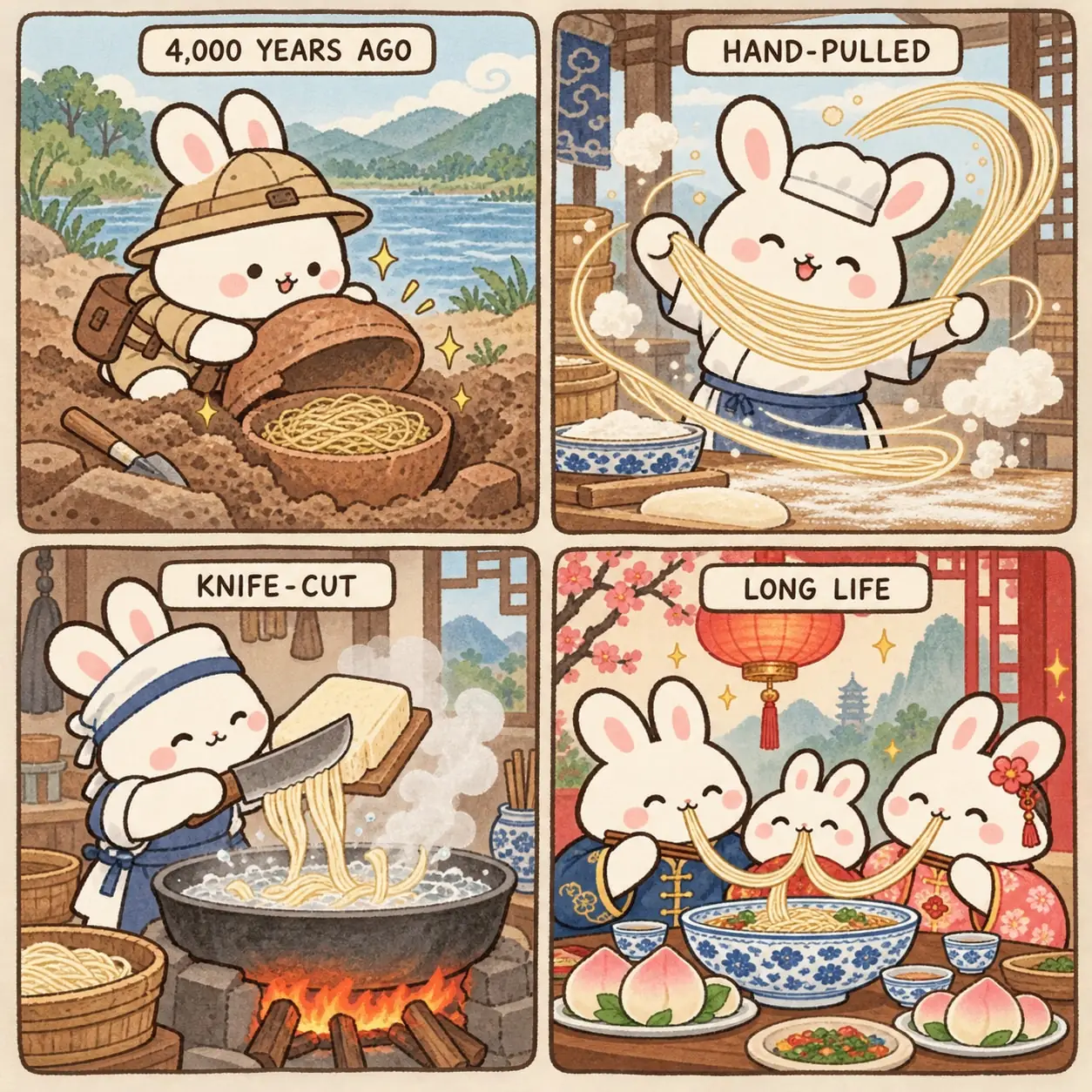
In 2005, a team led by Lu Houyuan of the Chinese Academy of Sciences reported something remarkable from Lajia, an archaeological site on the upper reaches of the Yellow River in north-west China. Buried in a layer of clay was an upturned bowl, and inside it were thin, yellow strands of noodles, about 4,000 years old. The find was published in Nature under the title “Millet noodles in Late Neolithic China”.
Until then, the earliest evidence for noodles was a Chinese written description roughly 1,900 years old. Lajia pushed the date back by more than two thousand years. The site itself had been buried by a sudden disaster around 1920 BCE, which is part of why the bowl survived; the cause is still debated, with earthquakes, floods and mudflows all proposed.
Two details make the story even better for noodle lovers. First, Lu described the strands as looking like la-mian, the hand-pulled noodles still made today by stretching and folding dough. Second, the recipe is a puzzle: the original analysis pointed to millet, but later experiments suggested millet alone could not hold together as a noodle, so other starches such as barley or wheat may have been involved. Four thousand years on, people are still arguing about the dough.
Pulled, cut and shaved: noodles as a craft
Over the following centuries, Chinese cooks developed a huge range of noodles, and many of the techniques are still the reference point for modern production. Lamian is made by twisting, stretching and folding dough into strands using its own weight. Knife-cut noodles from Shanxi are shaved straight off a block of dough into boiling water. Wide, belt-like biangbiang noodles from Shaanxi are pulled flat by hand.
Noodles also picked up meaning. Long noodles are served on birthdays as longevity noodles, and tradition says the strands should not be cut. Our own name comes from that world: 福壽, fú for blessing and shòu for longevity.
One old dish deserves a special mention because it looks like a preview of the instant noodle. Yi mein, named after the Qing official Yi Bingshou (1754–1815), is an egg noodle that is boiled and then fried, so it keeps well and comes back to life quickly in a broth or a sauce. The idea of cooking a noodle once, drying it, and finishing it later is older than any factory.
1958: instant noodles arrive
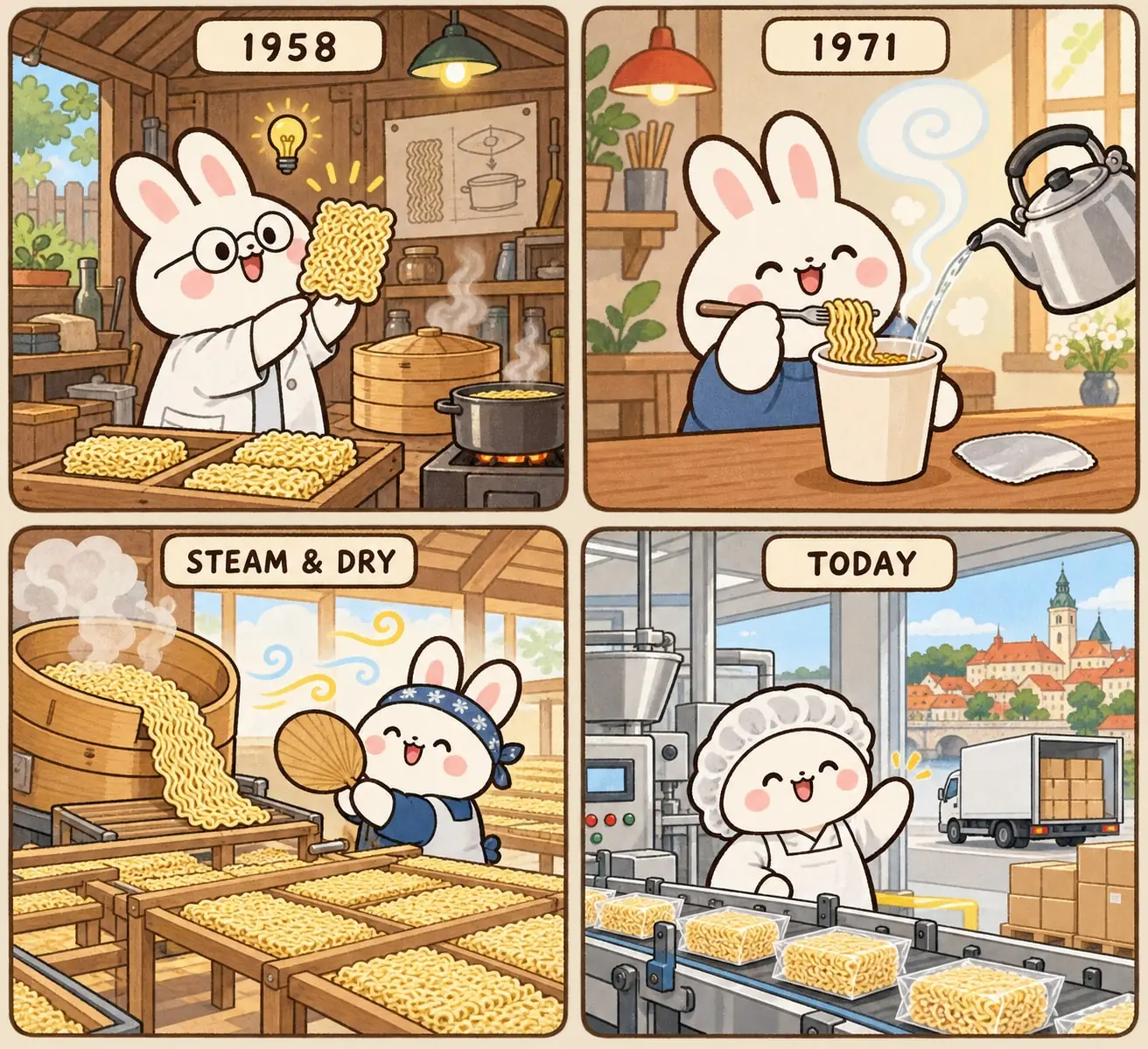
The modern story starts in Ikeda, Osaka. On 25 August 1958, Momofuku Ando, then 48, launched Chikin Ramen, the first packaged pre-cooked instant noodles. According to the Osaka tourism board, the product was made by seasoning steamed noodles and then frying and drying them. You poured boiling water over the block and it was ready in about two minutes.
It was not cheap. Chikin Ramen sold for ¥35, around six times the price of a portion of udon or soba at the time. People bought it anyway, because, as the Osaka tourism board puts it, it kept longer than even frozen noodles and needed no cooking skill at all.
History is rarely tidy, and this chapter has a footnote too: a Taiwanese inventor, Chang Kuo-wen, filed a patent for instant noodles in 1956, which was reportedly transferred to Ando’s company in 1961.
Frying as a drying method
The key to the 1958 noodle was flash-frying. Frying is a very fast way to remove water: cooked noodles spend one to two minutes in oil at 140–160 °C, and their moisture drops from 30–50 % to 2–5 %. The water boils out and leaves tiny pores behind, which is why a fried block rehydrates so quickly. The trade-off is that the noodle takes up oil in the fryer, typically around 15–20 % of its weight.
1971: the cup
In 1966, on a trip to the United States, Ando noticed people breaking noodle blocks into cups and eating them with forks. Cup Noodles went on sale on 18 September 1971 and reached the US a year later in a foam cup. Instant noodles became a global product.
The other path: steam, then dry
Frying was never the only way to remove water. Instant noodles can also be air-dried: after steaming, the noodles are dried in hot air at 70–90 °C for 30–40 minutes, ending at 8–12 % moisture. That is twenty times longer than a trip through the fryer, but there is no oil bath in the process at all.
The same source notes that frying still dominates in Asia, while air-dried noodles are favoured in Western countries. That fits how many European kitchens actually use noodles. A wok cook does not want a soup cube with a noodle attached; they want a plain noodle that is already cooked through, that takes a few minutes in boiling water or goes straight into the pan, and that holds its texture under sauce.
That is the category we call quick cooking noodles: noodles that are fully cooked at the factory, then dried without frying, and finished in the kitchen. A retail pack of our ramen-style noodles, for example, is labelled as pre-steamed with a cooking time of 3–4 minutes.
Europe today
Europe eats far fewer instant noodles than East and South-East Asia, but it is a growing market: one industry estimate puts the European instant noodle market at about USD 2.03 billion in 2025. Russia alone consumed about 2.2 billion servings in 2025.
The bigger change for professional kitchens is where the noodles come from. Asian-style noodles have long been an import product here. Making them in Europe shortens the chain: ingredients from the EU, production under EU food law, and delivery by truck rather than by sea.
Fushou Food was set up in the Czech Republic for exactly that reason. We make pre-cooked, non-fried noodles from 100 % EU ingredients in a HACCP-certified plant, and our range follows the old craft traditions: wavy mie, ramen in the lamian style, udon, soba, egg noodles, wide flat noodles and planed noodles in the dao xiao mian style. You can see the whole line-up on our products page.
What hasn’t changed
Four thousand years separate the Lajia bowl from a lunch rush in a Prague or Berlin wok bar, and the goal is surprisingly similar: a noodle that is easy to keep, quick to finish and good to eat. The tools have changed from hands and knives to steamers and drying tunnels, but a good noodle still starts with flour, water and a lot of patience.
If you run a kitchen or a distribution business and want to try our noodles, get in touch with us. And if you want to know more about how quick cooking noodles are made and used, read our guide What are quick cooking noodles?