Mie Keriting: Indonesia's curly noodles, now made in Europe

Order mie goreng at a street stall in Jakarta or bami goreng at a Dutch-Indonesian restaurant in Amsterdam, and the noodle on your plate will look the same: yellow, tightly curled and springy. That noodle has a name, Mie Keriting, and until now almost every pack sold in Europe has made a long sea journey from Indonesia. From January 2027, it will also be made in Europe, by us. Here is what Mie Keriting is and why that matters for kitchens and distributors.
What are Mie Keriting noodles?
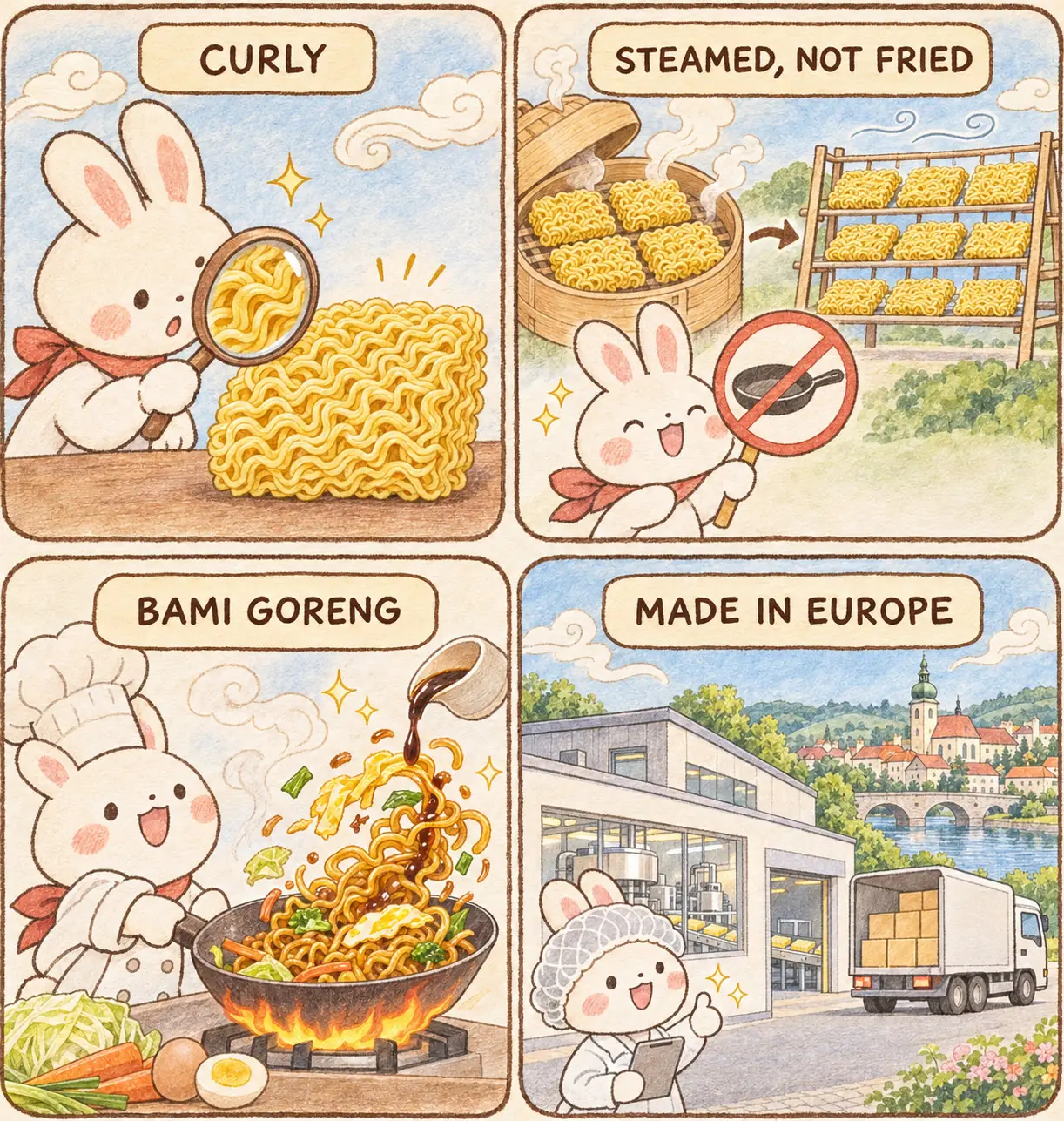
Mie Keriting means “curly noodles” in Indonesian, and they are the classic mie noodles of Indonesian cooking: mie is noodle, keriting is curly. They are wheat noodles that are formed into tight waves before they are cooked and dried, usually sold as compact square blocks.
The word mie comes from Chinese. Indonesian noodles in general developed from the cooking of Chinese settlers, and the name bakmi comes from two Hokkien words meaning “meat noodles”. Dutch borrowed mie and bami from it during the colonial period, which is why bami goreng is still on menus all over the Netherlands.
Our AFoodie Mie Keriting is steamed and air-dried, 100% oil-free and egg-free, and ready after 3 minutes in boiling water.
Why the curl matters
The curl is not decoration. It is what makes the classic dishes work:
- It holds sauce. The waves catch sweet soy sauce, oil and spices, so every bite is seasoned rather than the sauce pooling at the bottom of the wok.
- It stays loose. Curly noodles do not lie flat against each other, so they clump less in the wok and on a buffet.
- It keeps its bite. The springy, elastic texture survives high wok heat and a second toss in the pan.
That is why a cook making mie goreng, the Indonesian stir-fried noodle dish, wants this noodle and not spaghetti or straight egg noodles.
What are Mie Keriting noodles made of?
Our Mie Keriting is a wheat flour noodle with no egg, no oil and no preservatives. Many mie noodles sold in Europe are egg noodles or fried instant blocks; ours are neither. Here is how they are made:
- Mixing. Wheat flour and water, without egg, into a crumbly dough.
- Sheeting and cutting. The dough is rolled into a sheet and cut into thin strands.
- Curling. The strands are formed into the typical tight waves and portioned into blocks.
- Steaming. The blocks are steamed until cooked through.
- Air-drying. Instead of frying, the noodles are dried with hot air: no palm oil, no seed oils, no frying.
- Packing. Into 200 g retail packs; bulk HoReCa packs and private label on request.
Many curly noodle blocks on the market are fried, like classic instant noodles: they pick up oil in the fryer, typically 15–20% of their weight. Ours skip that step entirely. The noodle stays lighter and takes up sauce better, and the label stays short. For more on frying versus drying, see Pre-cooked noodles: what they are and how they’re made.
Mie Keriting vs egg noodles and imported mie noodles
| Mie Keriting (AFoodie) | Typical imported curly block | Straight egg noodles | |
|---|---|---|---|
| Shape | Tightly curled | Tightly curled | Straight |
| Drying | Steamed and air-dried | Often fried | Dried |
| Oil | 0% | Often 15–20% from frying | Low |
| Egg | No | Varies | Yes |
| Made in | Czech Republic, EU | Indonesia / Asia | Various |
| To Europe by | Truck, days | Sea freight, weeks | Various |
Bami goreng and mie goreng noodles: the classic dishes
- Mie goreng / bami goreng. Stir-fried noodles, also known as bakmi goreng, with garlic, shallots, vegetables, egg and chicken or shrimp, seasoned with sweet soy sauce (kecap manis). In the Netherlands, bami goreng is one of the most popular Indonesian dishes.
- Mie kuah. Noodle soup: the same curly noodle in a hot broth.
- Mie ayam. Noodles with seasoned chicken, a street food classic.
- Vegetarian wok dishes. Because our Mie Keriting has no egg and no oil, it fits plant-based menus with tofu, tempeh and vegetables.
For a tested mie goreng recipe with metric quantities and batch tips for restaurants, see Mie noodle recipes: mie goreng and yakisoba stir-fry.
How kitchens use Mie Keriting
Asian restaurants and wok bars
Simmer for 3 minutes, drain, and the noodle is ready for the wok. Many kitchens pre-cook a batch before service and finish each portion to order with sauce and toppings.
Dutch-Indonesian and Indonesian restaurants
For bami goreng and mie goreng, the curly noodle is not optional. A European supply means a steady stock without waiting for the next container.
Canteens, buffets and ready meals
Curly noodles hold sauce and stay loose on a hot counter, and they reheat well, which makes them a good base for ready meals and meal-prep bowls.
Asian supermarkets and retail
In 200 g packs, Mie Keriting is a shelf product for home cooks who want to make mie goreng without a flavour sachet, with their own sauces and spices.
Why choose a European Mie Keriting
- First and only in Europe. We are the first and only manufacturer in Europe making Mie Keriting.
- No sea freight. Delivered by truck across Europe within days, instead of around 90 days of sea freight and container rate swings.
- Clean label. 100% oil-free, egg-free, no preservatives.
- Food safety. Made under EU HACCP standards; IFS Food version 8 certification is in progress.
- Private label. Bulk HoReCa packs and your own brand on request.
For distributors and wholesalers: pre-order now
Until now, every distributor, wholesaler and Asian supermarket in Europe who wanted Mie Keriting had to import it from Indonesia, with long lead times, container costs and big minimum orders. We are the first and only manufacturer in Europe making these noodles. Production starts in January 2027, and pre-orders are open now:
- Priority production slot. Your stock allocation for Q1 2027 is guaranteed.
- Early-bird wholesale prices. Launch prices for full-pallet and full-truckload orders.
- Samples before launch. Pilot production samples to test in your own kitchen or lab.
If you are a distributor, wholesaler or Asian supermarket chain and Mie Keriting belongs in your range, reserve your volume for the first batch or contact us for samples and wholesale pricing.